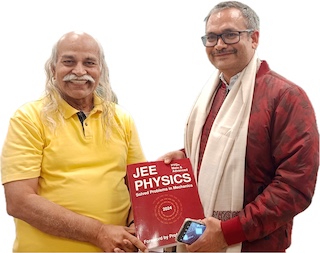
Doing PYQs for concept clarity... but coming back confused?
 By Bhavyaa
If you've ever prepared for JEE, you've probably heard this advice a hundred times:
"Solve as many previous year questions as you can."
And honestly, it's good advice.
Previous year questions aren't just useful for understanding the exam pattern. They're one of the best ways to strengthen your concepts. When you struggle with a question, make a mistake, and finally understand why, that learning stays with you.
Some questions are ambiguous. You can read them in two different ways and end up with two different answers. Sometimes the options don't even match the answer you've calculated. Sometimes the information given in the question contradicts what's actually being asked. Sometimes important data is missing, making the question impossible to solve. And the rarest—but also the most serious—is when the question has conceptual errors.
So calling out that JEE makes mistakes? Yes, exams are made by people, and mistakes can happen. What really matters is how those mistakes are handled.
Most resources simply accept the official answer key. Even with errors, they go ahead and build a solution around it, sometimes bending the Physics just to justify the answer.
As a student, that's frustrating. Because when you're learning, you trust the solution. If the solution is forcing an incorrect explanation, you don't just lose marks. You start doubting concepts that were actually correct. That's a much bigger problem.
PYQ Plus by Jitender Singh identified this pain point and took action.
Whenever the authors came across a flawed question, they didn't ignore it. They flagged it! Not to criticize the exam. But to save students from wasting time on wrong concepts, and save them from confusion.
Not only did they flag such questions with an EXCLAMATION MARK (!), immediately alerting the students to "proceed with caution", the book explained exactly what the issue was. Was the wording unclear? Was the data inconsistent? Was the official solution incomplete? Or did the question itself need to be corrected before it could be solved? Some of these explanations run for two or even three pages. Because they're making sure the student walks away with the correct understanding of Physics.
That, to me, completely changes the purpose of a solution. A solution isn't just supposed to help you reach the answer. It's supposed to help you understand the concept. And sometimes that means explaining why a question itself was flawed.
Ironically, these flawed questions often become some of the best learning opportunities. If a concept is tricky enough to confuse even the people setting the paper, then it's probably a concept worth understanding deeply. Those are the questions that leave you with a takeaway you'll remember for a long time.
That's why this feature stood out to me more than anything else in PYQ Plus. It isn't just about giving detailed solutions but also about being honest with students. It's about confidently calling out mistakes. That honesty builds trust.
It's built by acknowledging them, explaining them, and making sure students learn the right Physics. And that's probably my favourite thing about this book, another strong reason for you to consider PYQ Plus.
Illustration: A Flagged Question from IIT JEE 2022
Problem (!): Area of the cross-section of a wire is measured using a screw gauge. The pitch of the main scale is 0.5 mm. The circular scale has 100 divisions and for one full rotation of the circular scale, the main scale shifts by two divisions. The measured readings are listed in the table. What are the diameter and cross-sectional area of the wire measured using the screw gauge? (MSR is the main scale reading, and CSR is the circular scale reading) (IIT JEE 2022)
| Measurement Condition | MSR (divisions) | CSR (divisions) |
|---|---|---|
| Two arms of gauge touching each other without wire | 0 | 4 |
| Attempt-1: with wire | 4 | 20 |
| Attempt-2: with wire | 4 | 16 |
- (2.22 ± 0.02) mm, $\pi(1.23 \pm 0.02) \text{ mm}^2$
- (2.22 ± 0.01) mm, $\pi(1.23 \pm 0.01) \text{ mm}^2$
- (2.14 ± 0.02) mm, $\pi(1.14 \pm 0.02) \text{ mm}^2$
- (2.14 ± 0.01) mm, $\pi(1.14 \pm 0.01) \text{ mm}^2$
You can also watch the video explanation here:
PYQ Plus Solution & Analysis: This JEE Advanced 2022 problem lacks clarity.
Let us understand the issue. The pitch is defined for the 'screw gauge' and not for the 'main scale'. The pitch of a screw gauge is the distance moved (as seen on the main scale) in one complete rotation of the circular scale. It is given that pitch is 0.5 mm, and the main scale moves by 2 divisions in one complete rotation of the circular scale. Thus, each division on main scale is 0.25 mm. The main scale reading for wire diameter is 4 divisions. Thus, the diameter is of the order of 4 × 0.25 = 1 mm. But the given options are of the order of 2 mm.
We believe the sentence "The pitch of the main scale is 0.5 mm" shall be replaced by "One main scale division is 0.5 mm". Let us solve the problem after this correction i.e., taking 1 MSD = 0.5 mm.
The main scale moves by 2 divisions in one complete rotation of the circular scale. Thus, the pitch of the screw gauge is $p = 2\text{ MSD} = 2(0.5) =$ 1 mm. The circular scale has $N = 100$ divisions. The least count of the screw gauge is \begin{align} \text{LC} = \frac{p}{N} = \frac{1}{100} = 0.01 \text{ mm}.\nonumber \end{align}
The zero error of the screw gauge is \begin{align} \text{Zero Error} &= \text{MSR}_0 + \text{CSR}_0 \times \text{LC}\nonumber\\ &= 0 + 4(0.01) = 0.04 \text{ mm}.\nonumber \end{align}
The diameter measured in two attempts are \begin{align} D_1 &= \text{MSR}_1 + \text{CSR}_1 \times \text{LC} - \text{Zero Error}\nonumber\\ &= 4(0.5) + 20(0.01) - 0.04 = 2.16 \text{ mm}.\nonumber \\ D_2 &= \text{MSR}_2 + \text{CSR}_2 \times \text{LC} - \text{Zero Error}\nonumber\\ &= 4(0.5) + 16(0.01) - 0.04 = 2.12 \text{ mm}.\nonumber \end{align}
The average diameter of the wire is \begin{align} D = \frac{D_1 + D_2}{2} = 2.14 \text{ mm}.\nonumber \end{align} The measurement error is the same as the least count of the screw gauge. Thus, $D = (2.14 \pm 0.01) \text{ mm}$.
The cross-sectional area of the wire is \begin{align} A = \frac{\pi D^2}{4} = \frac{\pi (2.14)^2}{4} = \pi (1.1449) = \pi (1.14),\nonumber \end{align} where we used rules of truncation and significant figures. Differentiate the above expression to get the error in $A$ as \begin{align} \Delta A = \frac{\pi D\Delta D}{2} = \frac{\pi (2.14) (0.01)}{2} = \pi (0.01) \text{ mm}^2.\nonumber \end{align} Thus, $A = \pi(1.14 \pm 0.01) \text{ mm}^2$. The correct option is D.
Explore More About Measurement and Error Analysis
This question is from the Measurement and Error Analysis chapter. Understanding how to use instruments like screw gauge, vernier calipers, and error propagation is fundamental to experimental physics.
Related topics you may want to explore:
- Screw Gauge: Principle, Least Count, and Applications
- Vernier Calipers: Measurement Technique
- Error Propagation in Measurements
- Rules for Significant Figures
Keywords
[Jitender Singh, JEE Physics, PYQ Plus, Previous Year Questions, JEE Advanced, JEE Main, Flawed Questions, Ambiguous Questions, JEE Preparation, Problem Solving]