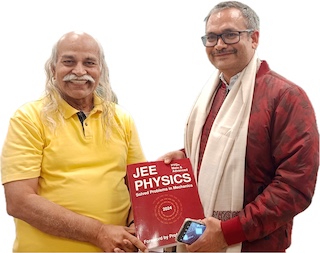
Challenge Exercises: The "Plus" in PYQ Plus
 By Bhavyaa
Every JEE aspirant eventually reaches a stage where one question comes to mind:
"I've solved all the PYQs. What should I solve next?"
It's a genuine question.
Classroom examples help you understand a concept. Previous Year Questions help you understand how that concept has been tested. Both are essential.
But neither fully prepares you for the one thing JEE Advanced is known for—asking questions you've never seen before.
That is exactly where the Challenge Exercises in PYQ Plus come in.
Why aren't PYQs alone enough?
PYQs are invaluable. They tell you the level of the examination, recurring concepts, common patterns, and the evolution of JEE over the years. But they also have a limitation.
By definition, they are questions that have already been asked.
JEE Advanced, however, rarely ever repeats questions. Every year, it presents familiar concepts through completely new situations. Success in the examination depends less on recognizing a question and more on applying concepts to something unfamiliar. And this application demands more than direct, routine-based thinking to get to the solutions.
That ability cannot be developed by solving only previous year questions. It has to be trained—it takes time, effort and a significant amount of practice with the right approach.
The Missing Step in Most Preparation
After completing chapter practice and solving PYQs, many students don't know where to go next. Some begin solving standard reference books. Others start attempting random coaching material. Unfortunately, both approaches come with a problem.
Books like I.E. Irodov, Krotov, S.S. Krotov, Morin, and many other higher-level Physics books contain hundreds or even thousands of excellent problems.
But not every problem is meant for a JEE aspirant. Some require university-level mathematics, and the idea is not to get great at heavy, advanced mathematics but to get good at understanding the core of Physics concepts. Some explore topics beyond the syllabus, which is not relevant for JEE preparation. Some are designed to illustrate beautiful physical ideas rather than examination-oriented thinking.
For a Class XI or XII student, identifying which questions are worth solving is difficult. A student may spend hours solving questions that contribute very little towards JEE preparation.
The challenge here is finding the right difficult questions.
What Makes Challenge Exercises Different?
The Challenge Exercises in PYQ Plus were created to bridge this gap. Every question has been carefully chosen or designed with one objective:
Prepare students for the kind of unseen questions JEE Advanced is known for asking.
These are not random difficult problems. Every question is relevant to the JEE syllabus. Every question reflects the level of thinking expected in the examination.
Many of the underlying ideas come from standard reference literature that has shaped Physics education for decades. The difference lies in the curation. Instead of expecting students to search through thousands of problems, PYQ Plus presents carefully selected and adapted questions that remain meaningful for JEE preparation.
The result is a collection of questions that are challenging without becoming irrelevant.
Designed by Someone Who Thinks Like a Physicist
Challenge Exercises are not merely collected from different sources.
They are curated and developed by an author who continues to solve Physics problems, studies the subject, and approaches Physics as a scientist and a lifelong learner. This distinction matters. A person deeply connected with the subject doesn't simply ask difficult questions. They first understand why a question is interesting, what makes the question difficult, and what is the concept hidden in the question. They recognize the physical principle behind it. They identify where students usually struggle.
Most importantly, they know how to convert a beautiful Physics idea into a meaningful JEE-level problem.
That depth of subject understanding is reflected throughout the Challenge Exercises.
Learning Begins Where Memorization Ends
One unique aspect of the Challenge Exercises is that they provide only hints and final answers. There are no complete step-by-step solutions. This is intentional.
Reading a solution is easy. Thinking through a problem is difficult. And it is precisely that struggle that strengthens conceptual understanding.
When a student tries multiple approaches, makes mistakes, revisits concepts, and finally arrives at the solution independently, the learning becomes permanent.
Instead of teaching students how one particular problem was solved, Challenge Exercises develop something much more valuable: The ability to solve the next unseen problem.
Nearly 800 New Questions
Every chapter concludes with Challenge Exercises, with around 10 to 12 questions each. Across the four volumes of PYQ Plus, this amounts to nearly 800 completely new questions. They represent the next stage of preparation after completing the PYQs.
If PYQs build familiarity with the examination, Challenge Exercises build the capability to face questions that students have never seen before.
Why This Approach Reflects JEE Advanced
The professors involved in designing JEE Advanced papers are also researchers and scholars deeply connected with Physics. Physics itself is a mature subject. The fundamental concepts have remained the same for generations. What changes is the creativity with which those concepts are applied.
Many JEE Advanced questions are inspired by ideas that have been studied and discussed in higher-level Physics for decades. What may appear completely new to a Class XII student is often a well-known concept among physicists and professors. The role of the paper setter is to transform these established ideas into questions that are relevant to the JEE syllabus while still testing deep conceptual understanding.
Every year, JEE Advanced presents fresh situations, new diagrams, unfamiliar contexts, and innovative combinations of concepts.
The questions are new but the concepts are still the same.
Challenge Exercises are built on the same philosophy. They take established physical ideas and present them as new, JEE-relevant problems that encourage genuine problem-solving rather than pattern recognition.
When Preparation Meets Reality
The effectiveness of this approach isn't merely theoretical.
One of the Challenge Exercises from PYQ Plus appeared in Paper 2 of JEE Advanced 2025.
This does not mean the book predicts future questions. Rather, it demonstrates something more important. When preparation is based on strong concepts and problem solving done on quality questions, students naturally become ready for the kind of questions that examinations eventually ask.
Illustration: A Challenge Exercise from PYQ Plus
Watch the video explanation:
Problem: A vertical lifting mechanism uses a compressed spring to raise objects from the Earth's surface. As the object rises, the spring relaxes and the upward force it exerts decreases linearly with height. The vertical upward force exerted on an object of mass $m$, which is rigidly attached to the top of the mechanism, is \begin{align} F(x)=2mg\left(1-\frac{x}{x_0}\right), \end{align} where $x_0$ is a positive constant, $x$ is the height above the surface, and $g$ is the acceleration due to gravity. The only other force acting on the object is its weight. The object is raised from rest at $x=0$.
- Find the maximum height reached by the object.
- Find the work done by the applied force during the first half of the ascent.
Hint: At the maximum height the velocity becomes zero, so the total work done by all the force up to that point must be zero.
Answer: (a) $x_0$ (b) $\frac{3}{4}mgx_0$
This problem is inspired by I.E. Irodov (Problem 1.130) and is part of the Work, Energy & Power chapter's Challenge Exercises in PYQ Plus. Try to solve it independently—it's the struggle that builds true problem-solving capability.
Beyond PYQs
PYQs will always remain one of the most important resources for JEE preparation. But they are not the final destination. They tell you what has already been asked. Challenge Exercises prepare you for what can be asked.
That is the reason they exist. And that is why they are called the "Plus" in PYQ Plus.
Related Articles
Keywords
[Jitender Singh, JEE Physics, PYQ Plus, Challenge Exercises, Previous Year Questions, JEE Advanced, JEE Main, Irodov, Krotov, Morin, HC Verma, Resnick Halliday, Problem Solving, JEE Preparation, Concept Clarity, Unseen Questions]