A bimetallic strip is formed out of two identical strips - Thermal Expansion Problem
 By
Problem: A bimetallic strip is formed out of two identical strips - one of copper and the other of brass. The coefficients of linear expansion of the two metals are $\alpha_C$ and $\alpha_B$. On heating, the temperature of the strip goes up by $\Delta T$ and the strip bends to form an arc of radius of curvature $R$. Then, $R$ is, (IIT JEE 1999)
- proportional to $\Delta T$.
- inversely proportional to $\Delta T$.
- proportional to $|\alpha_B -\alpha_C|$.
- inversely proportional to $|\alpha_B -\alpha_C|$.
Solution: Let $d$ and $l_0$ be width and initial length of the two strips. The length of the strips after heating becomes, \begin{align} l_C&=l_0(1+\alpha_C\Delta T), \nonumber\\ l_B&=l_0(1+\alpha_B\Delta T).\nonumber \end{align}
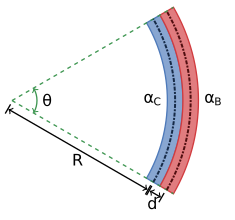
The strips bend as shown in the figure. From figure, the length of the two strips are \begin{align} l_C&=R\theta, \nonumber\\ l_B&=(R+d)\theta. \nonumber \end{align} Divide to get, \begin{align} \label{jqa:eqn:1} \frac{R+d}{R}&=\frac{l_B}{l_C}=\frac{1+\alpha_B\Delta T}{1+\alpha_C\Delta T}\nonumber\\ &=(1+\alpha_B\Delta T)(1+\alpha_C\Delta T)^{-1}\nonumber\\ &\approx (1+\alpha_B\Delta T)(1-\alpha_C\Delta T) \nonumber\\ &\approx 1+(\alpha_B-\alpha_C)\Delta T, \end{align} where we neglected higher order terms. Simplify above equation to get, \begin{align} \label{jga:eqn:2} R=\frac{d}{(\alpha_B-\alpha_C)\Delta T}. \end{align} The bending shown in figure assume $\alpha_B > \alpha_C$ (which is generally the case for brass and copper). If $\alpha_B < \alpha_C$, bending of strip will be in opposite direction. To take care of both cases, above equation is written as, \begin{align} R=\frac{d}{|\alpha_B-\alpha_C|\,\Delta T}.\nonumber \end{align}
More on Thermal Expansion
- Problem from IIT JEE 2008 - Voumetric expansion of a gas
- Problem from IIT JEE 2004 - A cube of coefficient of linear expansion α and volume expansion γ
- Problem from IIT JEE 2003 - Two rods, one of aluminium and the other made of steel
- Concepts and Problems on Thermal Expansion of Solids, Liquids and Gases